

Leading Gafieira Rio Miami, Diogo Brown wants to bring samba closer to the city his band calls home. Beleza Pura puts that relationship into the repertoire – and leaves the audience with a question: can you stay in your seat?
Jorge Ben Jor wanted to meet him. At least that was what the friend who invited Diogo Brown to Dante’s Hi-Fi in Miami had said. His name was on the list. All he had to do was show up.
Diogo decided to get a little rest before heading out.
He woke up at two in the morning.
“Fuck, I can’t believe it, man.”
He tells the story when asked where he would take his greatest idol if they could meet in the city. His answer begins as a fan’s hypothetical outing: go to Dante’s and listen to Ben Jor’s records alongside the man himself. Then it turns out the opportunity had actually existed. This imaginary encounter had an address and an invitation. The bassist was the missing piece.
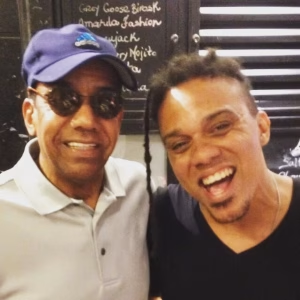
It is a particularly cruel story for someone who, given the chance to make the entire planet dance to one Brazilian song, chooses “Mas Que Nada.” Diogo asks for just one stipulation: the version by Gafieira Rio Miami, the band he founded and leads. His admiration for Jorge allows for a little competition when it comes to the arrangement.
That recording appears on Beleza Pura, the group’s second album, featuring Tony Succar and Eylen Remon. It also brings together two answers that, in conversation with Diogo, initially seem to head in opposite directions. He wants foreign audiences to learn to distinguish Brazilian music from that of its neighbors. And he wants to bring those neighbors closer.
When discussing what Americans misunderstand about Brazil, the bassist grows impatient with the ease with which an entire continent fits into a single musical category.
“They think that because we’re in South America, we’re all doing the same thing.”
To explain the scale of the mistake, he turns to Brazil itself. Even within the country, that supposed uniformity falls apart. Move from one region to another, he says, and the way people speak changes. “Even the way people walk changes.”
The observation about walking is more precise than he may have intended. For a musician interested in gafieira, cultural differences also reveal themselves in how people move across a floor. The body has its own accents.
Diogo, however, has no intention of spending his life correcting people who confuse samba with salsa. He wants to play with people who know salsa from the inside.

That is how Tony Succar enters the conversation. Born in Lima and raised in Miami, the percussionist and producer embodies the very geography the project is looking to
embrace. Diogo has appointed him “the mayor of Miami.” The title is a joke; his musical role is quite specific. Succar brought the album the “salsa side” the bassist wanted to draw into the band.
“After all, it’s a project that lives there.”
The line passes quickly, but it explains the decision better than a speech about going international. If the band lives in Miami, what happens in that city can find its way into the music. The question expands beyond how much of Brazil can be preserved at a distance to include what the musicians do with the people around them.

That is already apparent in the lineup: Gafieira Rio Miami is an eleven-piece band with musicians from Brazil, Venezuela, and the United States. Released in October 2025, Beleza Pura was recorded between Rio and Miami. Its guests include Roberta Sá and Yamandu Costa, alongside pianist Antonio Adolfo and flutist Nestor Torres. Isa Duarte’s voice is at the heart of the band.
Projects like this face a familiar risk: the city becoming an adjective. “Cosmopolitan” can describe the work of people learning to play together just as easily as it can excuse anyone from explaining that work. Diogo’s intentions become more interesting when he drops the broad terms and talks about what he is after: samba meeting salsa, music for dancers, room for those who would rather listen.
What is at stake has a history that predates Miami. Rio’s gafieira dance halls were already meeting places for different repertoires, with samba sharing the floor with other dance music. Jazz is part of that history. Musical exchange hardly needs to be presented as a novelty that Brazilian music acquired with a passport.
What is new is who is meeting now, and the circumstances that allow—or make it harder for—the dance to happen.

Keeping eleven musicians playing together is a deliberate choice of scale. Gafieira Rio Miami depends on instrumentalists coming together and on an audience willing to spend time in their presence. There is something demanding about that ambition, particularly when a recording can supply the music for a dance. Diogo insists on the band.
When he discusses what he wants to bring back, he means the practice of making music for partner dancing. In his view, that custom has lost ground, and the group has been helping cultivate it again. The claim deserves to be understood on its own terms: samba de gafieira did not wait for Miami to keep existing. Diogo’s work is to make room for it in the circumstances in which he now operates.
In July 2025, one of those settings was Lincoln Center’s outdoor dance floor in New York. Gafieira Rio Miami appeared as part of Brazil Week in a space called, unambiguously, The Dance Floor. Within an institution associated with concert listening, there was ground set aside for dancing.
The detail matters because Diogo knows the opposite situation, too.
“Sometimes we play a theater for 300 people, everyone sitting there, nice and proper, listening.”
He says this without complaint. He makes a point of including the music lover who has not come to dance. The band needs to work for that person, too.
Still, the image contains a small complication for any gafieira project. An attentive audience can appreciate the musicians’ work, follow a solo, and applaud at the right moment. On a dance floor, the response arrives while the music is still being played. A couple moves closer. Another needs room to turn. The music changes how people move around one another, and the musicians can see what it sets in motion before reaching the final chord.
 They are different experiences for the same band. Diogo wants to sustain both.
Perhaps that explains why his idea of the future seems so unconcerned with breaking from the past. Asked what he would want someone to hear in Beleza Pura thirty years from now, he hopes the album will still sound modern. That ambition rests partly on a practice he himself associates with earlier decades.
For him, this dance still has a future. The lineup can keep welcoming other musicians; the repertoire can take on new inflections. Miami offers material for that without requiring the group to stop thinking of itself as Brazilian.
When asked to give the album a nationality, Diogo does not hesitate: its passport would be Brazilian, with visas from elsewhere. The image has the casual assurance of someone explaining a decision already made through his work. He knows where the music he wants to make comes from. He is interested in what might still happen to it.
It is revealing that, given any song and five minutes of worldwide obedience, he asked for “Mas Que Nada.” He could have championed an obscure discovery or used the question to improve everyone else’s taste. He chose a familiar song and insisted on his band’s version.
Jorge Ben Jor did not meet him at Dante’s that night. On Beleza Pura, the encounter found its way into a song – with other guests, and work for the bassist.